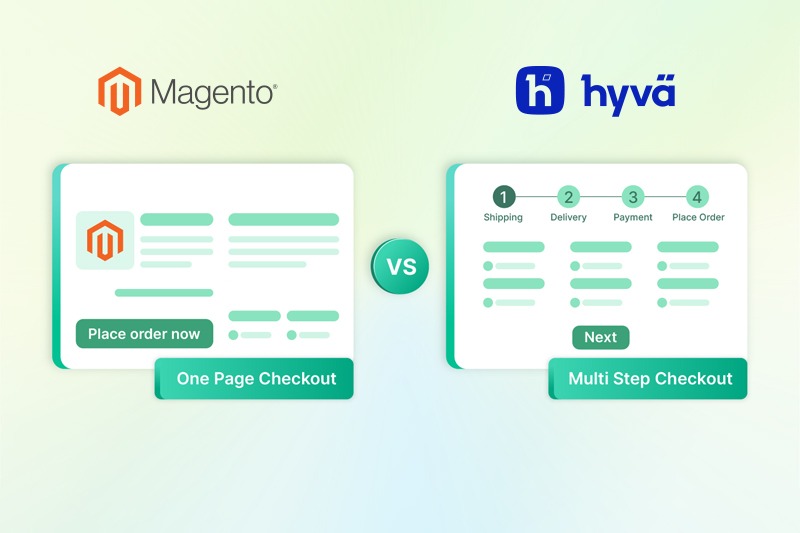
Hyvä Checkout vs Default Magento Checkout: Speed, UX, and Conversion Impact (Real-World Takeaways)
by Rahul Basu
February 2,2026
If you run an Adobe Commerce or Magento Open Source store, you know how the checkout process works. It is either secured or quietly lost. Months of struggling on product pages, doing extensive SEO won’t work if the checkout is slow, or bit too much. You will lose on customers. Hyvä Checkout vs the default Magento checkout is now the main topic of discussion for merchants who care about performance and conversion.
At Ingold Solutions, a Magento agency in Berlin, we’re often asked a simple question: Is Hyvä Checkout really worth it? The honest answer is: it depends on your store, your audience, and your growth goals. But in many real-world projects, Hyvä Checkout is one of the highest-leverage upgrades you can make—especially when speed, UX, and maintainability matter.
This blog breaks down the differences between Hyvä Checkout and the default Magento Luma-based checkout, focusing on practical outcomes: speed, user experience, conversion impact, and implementation effort—without hype.
Why Checkout Performance Matters More Than Most Merchants Think
Checkout is not just another page. It’s a multi-step process where users are anxious, impatient, and highly sensitive to friction. Every extra second, every confusing label, every unnecessary field increases the chance they abandon their cart. Checkout optimisation affects:- Conversion rate (directly tied to revenue)
- Core Web Vitals and perceived speed
- Mobile usability (where most friction happens)
- Customer trust (especially for first-time buyers)
- Support load (fewer “I can’t pay” tickets)
Default Magento Checkout: Strengths and Limitations
Magento’s default checkout is powerful and feature-rich. It supports complex pricing, multi-shipping (in some setups), guest checkout, and a broad ecosystem of payment/shipping integrations. For many stores, it works fine out of the box. But the default checkout has well-known challenges:1) Heavier Frontend Stack
Traditional Magento frontends (Luma-based) are built around Knockout.js and UI components that can become heavy—especially when multiple third-party modules inject scripts and UI blocks into checkout. The result can be:- Longer time-to-interactive
- Slower form responsiveness on mobile
- Extra requests, extra JavaScript, extra layout overhead
2) Extension Conflicts at Checkout
Checkout is where extension conflicts are most visible. It’s common to see:- Shipping methods not loading
- Payment method UI breaking
- Validation loops or “stuck” steps
- Performance dips from tracking scripts
3) UX That Often Needs Customisation
Magento’s default checkout can be made great—but it usually requires UX and frontend engineering work:- Reducing fields
- Adjusting step order
- Improving error messages
- Optimising mobile layout
- Simplifying account creation
Hyvä Checkout: What It Is and Why It’s Different
Hyvä is best known for the Hyvä Theme, which modernises Magento storefront performance by reducing complexity and heavy JavaScript. Hyvä Checkout follows the same philosophy: build a checkout experience that is faster, cleaner, and easier to maintain. In practice, Hyvä Checkout typically delivers:- A more lightweight frontend
- Faster perceived interactions (especially on mobile)
- A simpler structure to customise
- A modern approach to UI behaviour
Speed Comparison: Where Hyvä Checkout Usually Wins
Speed is not only “page load.” It’s how quickly a user can act—select shipping, enter address, switch payment methods, place the order—without delays.Default Magento Checkout: Common Speed Bottlenecks
- Heavy JS initialisation
- Multiple UI components loaded even when not needed
- Third-party scripts competing for resources
- Theme-level performance limitations
Hyvä Checkout: Typical Speed Advantages
- Less frontend overhead
- More direct rendering and responsiveness
- Faster step transitions
- Better mobile performance under real network conditions
UX Comparison: Friction vs Flow
A fast checkout is great. But speed alone doesn’t guarantee conversions. UX matters just as much—sometimes more.Default Magento Checkout UX: What Often Hurts Conversions
- Too many visible elements and distractions
- Clunky validation messaging
- Long forms with unnecessary fields
- Unclear step progress
- Payment/shipping selection that feels “technical”
- Cleaner layout with less clutter
- Faster feedback when selecting options
- Better mobile usability by default
- A more modern form experience
Conversion Impact: What Actually Changes?
Merchants often ask for guaranteed conversion lifts. No serious Magento agency in Berlin should promise a fixed percentage—conversion depends on product-market fit, pricing, trust signals, shipping cost, payment options, and customer intent. But here are the conversion dynamics we commonly see when checkout improves: 1) Mobile Conversion Improves First Mobile users are less forgiving. Faster step response and clearer forms often reduce abandonment. 2) Fewer Checkout Errors = Fewer Drop-offs Cleaner checkout UX and fewer extension conflicts mean fewer failed attempts. 3) More “Confidence” at Payment Step A checkout that feels stable and quick increases user trust—especially for first-time visitors. 4) Better Support for Rapid Optimisation Hyvä Checkout can be easier to iterate on. Iteration is where conversion improvements compound over time. Real-world takeaway: The biggest conversion gains often come not from one big change, but from a checkout experience that is fast enough and clean enough to let you continuously optimise without breaking things.Implementation Reality: What Merchants Need to Know
Here’s the part many blogs skip: implementation. When Hyvä Checkout Is Usually a Great Fit Hyvä Checkout can be an excellent choice if:- You care about performance and Core Web Vitals
- Your default checkout has become slow or fragile
- You want a checkout that’s easier to customise cleanly
- Your roadmap includes UX optimisation and A/B testing
- You want long-term maintainability
- Your checkout is already fast and stable
- You rely on niche payment/shipping modules that are hard to replace
- Your checkout has highly complex custom logic tied to legacy UI components
- You’re planning a broader re-platforming soon (and want minimal changes now)
- Checkout speed (real mobile)
- JS payload and render delays
- Extension conflicts
- Drop-off points and analytics quality
- Payment/shipping reliability
- Form friction and field necessity
- Optimise the default checkout properly, or
- Move to Hyvä Checkout, with a clear plan for compatibility and testing
SEO and Performance: The Indirect Benefits
Checkout pages are not usually indexed. But checkout performance improvements often correlate with broader storefront improvements—especially when Hyvä Theme is part of the stack. Merchants who invest in faster frontend performance typically see:- Better Core Web Vitals
- Improved bounce rate and session depth
- Higher add-to-cart rates (because the site feels better overall)
- Stronger mobile experience
Final Verdict: Hyvä Checkout vs Default Magento Checkout
If your store is growing and checkout is becoming a bottleneck, Hyvä Checkout is often one of the most effective upgrades you can make for speed and UX—especially on mobile. The default Magento checkout remains capable, but it can become heavy and harder to maintain as extensions and customisations accumulate. The best choice is the one that:- Improves customer flow
- Reduces technical risk at checkout
- Supports your payment/shipping needs
- Gives you a clean foundation for optimisation
- Fits your roadmap and budget